
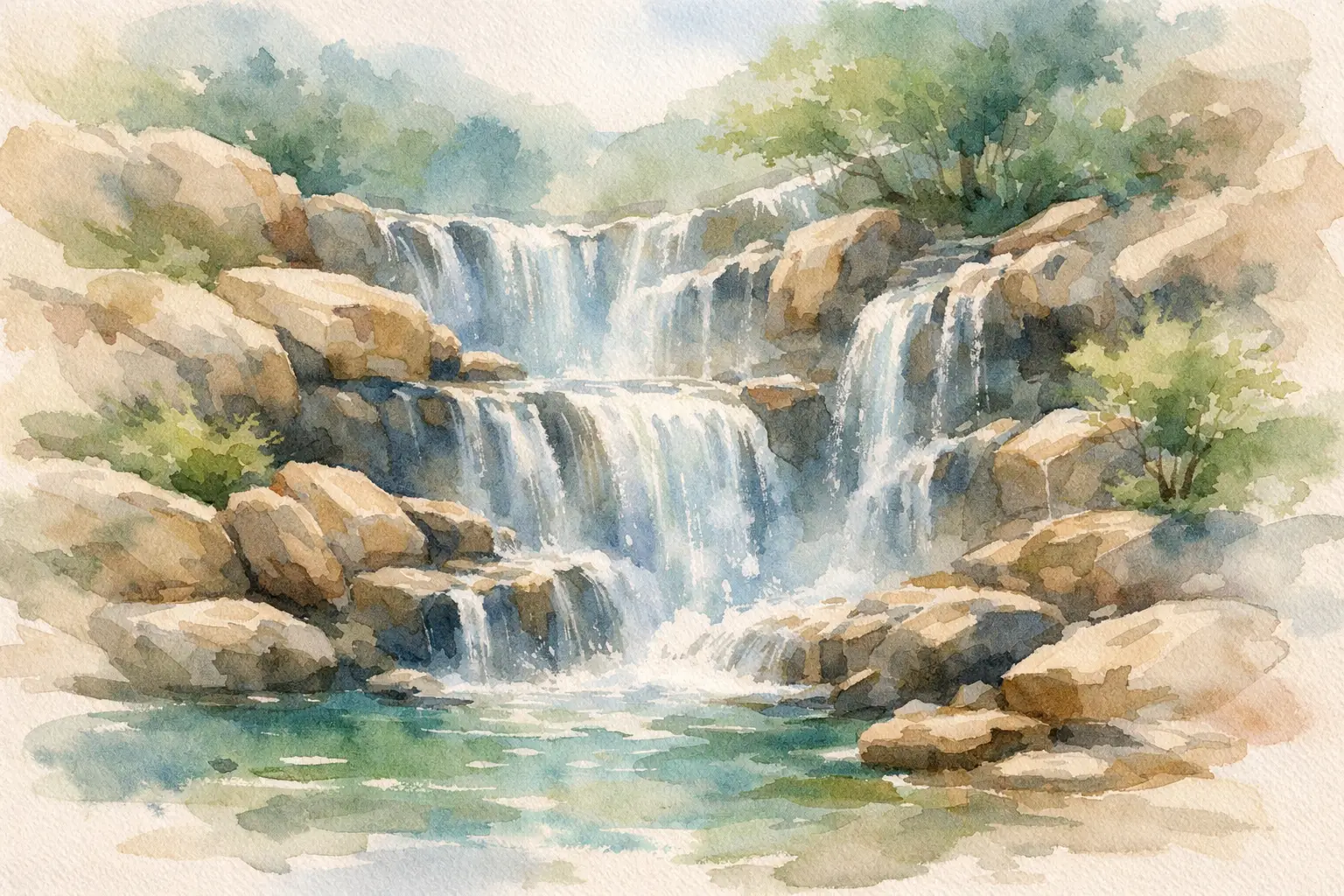
A convincing waterfall should never look as though it arrived in a crate. The best natural stone waterfall design feels like it belongs to the property – shaped by the grade, tucked into planting, and built with the kind of irregularity that makes nature so compelling. Water should travel with purpose, catch the light in unexpected places, and create a sound that invites you outdoors without overwhelming a conversation on the patio.
That effect is not accidental. It comes from a careful marriage of artistic stone placement, water-flow engineering, and a real understanding of how people will live around the feature for years to come. Whether the vision is a small pondless waterfall beside a seating area or a dramatic cascade feeding a large koi pond or recreation pond, the details beneath and behind the stone determine whether it remains beautiful and dependable.
What Makes a Natural Stone Waterfall Design Believable?
Natural does not mean random. In a successful waterfall, every boulder, shelf stone, and gravel transition has a job. Some stones establish the visual backbone. Others direct water, hide liner edges, support planting pockets, or create quiet pools between more energetic drops. The final composition may look effortless, but it is carefully constructed from the ground up.
Scale is where many waterfall projects either come alive or feel out of place. A waterfall that is too small for a broad backyard can disappear visually and sound weak. One that is oversized for its surroundings can feel forced, even when the stone itself is beautiful. The appropriate width, elevation change, and flow rate depend on the viewing distance, nearby architecture, property grade, and the experience the owner wants to create.
A compact courtyard waterfall may need just enough movement to soften street noise and bring a reflective calm to an intimate outdoor room. A larger property may call for a series of cascades that can be enjoyed from the house, the pool, and a distant garden path. The goal is not simply a bigger waterfall. It is a feature with the right presence.
The stone needs character, not repetition
Naturalistic construction starts with real stone selected for shape, texture, and local visual compatibility. Flat shelf stones can create crisp falling water, while more irregular boulders establish the rougher, weathered structure seen along a creek bed. Stones with varied faces, tones, and profiles prevent the feature from looking assembled in layers.
Just as important is avoiding the “rock pile” effect. Each stone should appear anchored, with much of its mass set below grade or nested into the surrounding terrain. Visible gaps are softened through smaller accent stone, gravel, mossy planting, and thoughtful transitions into the landscape. A waterfall should feel like it emerges from the land, rather than sitting on top of it.
Water must move in a way that matches the setting
Water behavior is part of the design language. A sheer drop creates a clean, brighter sound and a strong visual line. Water spilling over a slightly uneven ledge creates a softer veil. A sequence of short cascades offers texture and movement, while a deeper basin can slow the water and add a moment of stillness.
The right approach depends on the desired atmosphere. Homeowners seeking a peaceful retreat may prefer a lower, layered flow that can be heard close by without dominating the yard. Those trying to mask traffic or neighborhood noise may benefit from a more energetic drop and increased flow. A skilled designer balances sound with comfort, especially near bedrooms, outdoor kitchens, and conversation areas.
Start With the Landscape, Not a Standard Waterfall Kit
Every property brings its own opportunities and constraints. Existing slope can make a waterfall feel remarkably natural, but even a relatively flat yard can support a convincing elevation change when the earthwork and stonework are handled properly. The design should respond to sightlines from inside the home, circulation through the yard, sunlight exposure, drainage patterns, and adjacent structures.
In the Bay Area, those details can vary dramatically from one neighborhood to the next. A hillside property may require careful grading, retaining considerations, and secure stone placement. A smaller suburban lot may need privacy planting and a waterfall positioned to be enjoyed from a kitchen window or patio. Dry summers also make efficient water management and practical access for service especially valuable.
Before construction begins, it helps to answer a few experiential questions. Is the waterfall meant to be the primary focal point or a discovery along a garden path? Will children interact with the area? Should it feed a pond with fish, disappear into a hidden reservoir, or become part of a larger natural swimming environment? These choices affect everything from stone size to filtration, pump capacity, and maintenance access.
Pondless, Pond, and Recreation Waterfalls Serve Different Purposes
A waterfall can be designed around several types of water environments. Choosing the right one early prevents a feature from being beautiful but poorly suited to the way the property is used.
A pondless waterfall recirculates water into a concealed underground reservoir. It is an excellent option for homeowners who want the sound and motion of moving water without an open pond. It can fit near entries, patios, narrow side yards, or family gathering spaces, and it generally offers a simpler maintenance routine. The reservoir must still be sized correctly, and the system needs reliable access points for the pump and plumbing.
A pond waterfall creates a more complete water-garden setting. The falls can oxygenate the pond while serving as the dramatic visual source of the water. Koi, aquatic plants, and surrounding habitat add layers of life and seasonal interest. This option requires a thoughtful ecosystem plan, including filtration, circulation, depth, planting zones, and an approach to fish care.
For substantial properties, a waterfall can become part of a recreation pond or natural swim pond. These projects require a far deeper level of planning because water quality, swimming zones, safety, circulation, and large-scale grading must all work together. When done well, the result is more than an amenity. It becomes a remarkable outdoor destination for family life, entertaining, and quiet moments near the water.
The Hidden Construction Is What Protects the Beauty
A waterfall is only as dependable as the system concealed beneath its finished surface. Liner, underlayment, plumbing, pump selection, filtration, and stone support all deserve as much attention as the visible cascade. Cutting corners here can lead to shifting stone, poor water distribution, recurring leaks, or a feature that loses water faster than expected.
Proper excavation establishes the form and supports the intended stream path. A durable underlayment and high-quality liner protect the system from the ground and stone above. Plumbing is sized for the desired flow and routed for serviceability. Heavy boulders are placed with equipment and secured on stable bearing points rather than balanced precariously over soft soil or loose fill.
Waterproofing is not simply about keeping water in the feature. It is also about keeping surrounding soil where it belongs. If water escapes behind the liner or outside the intended channel, it can erode the structure, settle stone, and create difficult-to-diagnose problems. Experienced builders test flow during construction, adjusting spill stones and edge treatments until water returns cleanly to the pond or reservoir.
This is why a low-maintenance waterfall does not mean a no-care waterfall. Seasonal cleaning, debris removal, pump checks, and occasional adjustments preserve performance. Features with good access and quality components are far easier to care for than installations that hide every critical part of the system.
Planting Turns Stone and Water Into a Living Landscape
Planting is often the difference between a newly built waterfall and a natural sanctuary. The right plant palette softens hard edges, provides color and texture through the seasons, and helps blend the feature into the rest of the garden. Ferns, grasses, groundcovers, and carefully selected shrubs can create the layered feeling of a creekside setting without obstructing water flow or access for maintenance.
Plant choices should fit the site rather than follow a fixed formula. Sun exposure, irrigation needs, mature plant size, and the surrounding landscape all matter. A lush, shaded look may be possible in one location, while another will be better served by a drought-conscious composition that complements California’s climate and still feels generous around the stone.
Lighting adds another dimension after sunset. Subtle illumination under a spillway, within a stream, or across selected boulders can reveal the movement of water without turning the feature into a stage set. Less is often more. The light should support the water and stone, not compete with them.
Design for the View You Will Have Every Day
The best viewpoint is rarely just one. A waterfall may be seen from a living-room window in the morning, beside the patio at dinner, and from across the yard when guests arrive. Designing for those moments helps determine the feature’s orientation, height, sound level, and planting layout.
It also means planning for life beyond installation day. Make sure service areas are reachable. Consider how leaves, wind, and nearby trees will affect the water. Leave enough room for the landscape to mature naturally. If a future patio, outdoor kitchen, or pool is part of the long-term plan, the waterfall should be positioned to complement that evolution instead of becoming an obstacle.
At Aquascape Creations, we believe the most memorable water features begin with listening closely to how a family wants to use its outdoor space. A well-built waterfall should offer more than a beautiful first impression. It should become the place where children pause to watch the water, where guests linger after dinner, and where the ordinary pace of the day gives way to something quieter and more alive.
When your landscape is ready for that kind of transformation, begin with the site itself – its slope, its views, its daily rhythms, and the feeling you want to come home to. The right stone, water, and craftsmanship can turn those details into a living masterpiece that feels as though it has always been there.
Found this gem while searching for new sports books and I am genuinely impressed. The odds are fair and I love how clean the interface looks on my phone. Customer service handled my withdrawal request without any headaches. Highly recommend it to anyone who enjoys a smooth betting flow. coholiganbet