A waterfall that suddenly needs more water is not merely an inconvenience. It can saturate planting beds, undermine stonework, strain a pump, and take some of the peace out of a landscape feature built to be enjoyed. Knowing how to diagnose waterfall leaks starts with one reassuring principle: not every water loss is a liner failure. Evaporation, splash, plumbing, stream edges, and reservoir levels can all tell a different story.
The goal is not to start pulling apart boulders or replacing materials prematurely. It is to isolate the system, observe what changes, and let the evidence guide the repair. A careful diagnosis protects both the function and the natural beauty of your water feature.
Start by Confirming That It Is Actually a Leak
In the Bay Area, warm weather, wind, and low humidity can make evaporation surprisingly noticeable, especially on a broad, active waterfall. A feature with several cascades exposes more water to moving air than a still pond, so it will naturally lose more water during hot or breezy periods.
Before assuming the worst, bring the water to its normal operating level and mark that level with a small piece of tape, a pencil mark on a skimmer faceplate, or a reference point on the basin. Turn off any automatic fill device for the test period. Then monitor the drop over 24 hours under reasonably typical conditions.
A modest, consistent decline may be evaporation. A rapid loss, a wet area that keeps expanding, or a water level that stops dropping at the same point each time points toward a leak. Keep in mind that a new feature may also need minor adjustments as water finds its natural path across stones and edges. That is different from an ongoing loss that worsens or requires daily refilling.
Separate the Pond From the Waterfall
The most useful diagnostic test is also one of the simplest: turn off the pump.
With the pump off, the waterfall and stream stop circulating while the pond or underground reservoir remains full. Mark the water level, wait 12 to 24 hours, and check it again. If the water level holds steady, the leak is likely in the waterfall, stream, plumbing under pressure, or a fitting that leaks only while the pump is running.
If the water continues to drop with the pump off, the issue is more likely in the pond shell, lower reservoir, skimmer, intake bay, or another component that remains submerged. The level where the water finally stabilizes is particularly valuable. It often reveals the approximate elevation of the problem.
For a pondless waterfall, this test works a little differently because water settles into an underground reservoir rather than an open pond. Shut off the pump and observe whether the reservoir holds water. If it does, focus attention on the stream and waterfall. If it does not, the issue may be in the reservoir liner, vault area, plumbing, or an overflow path.
Inspect the Waterfall While It Is Running
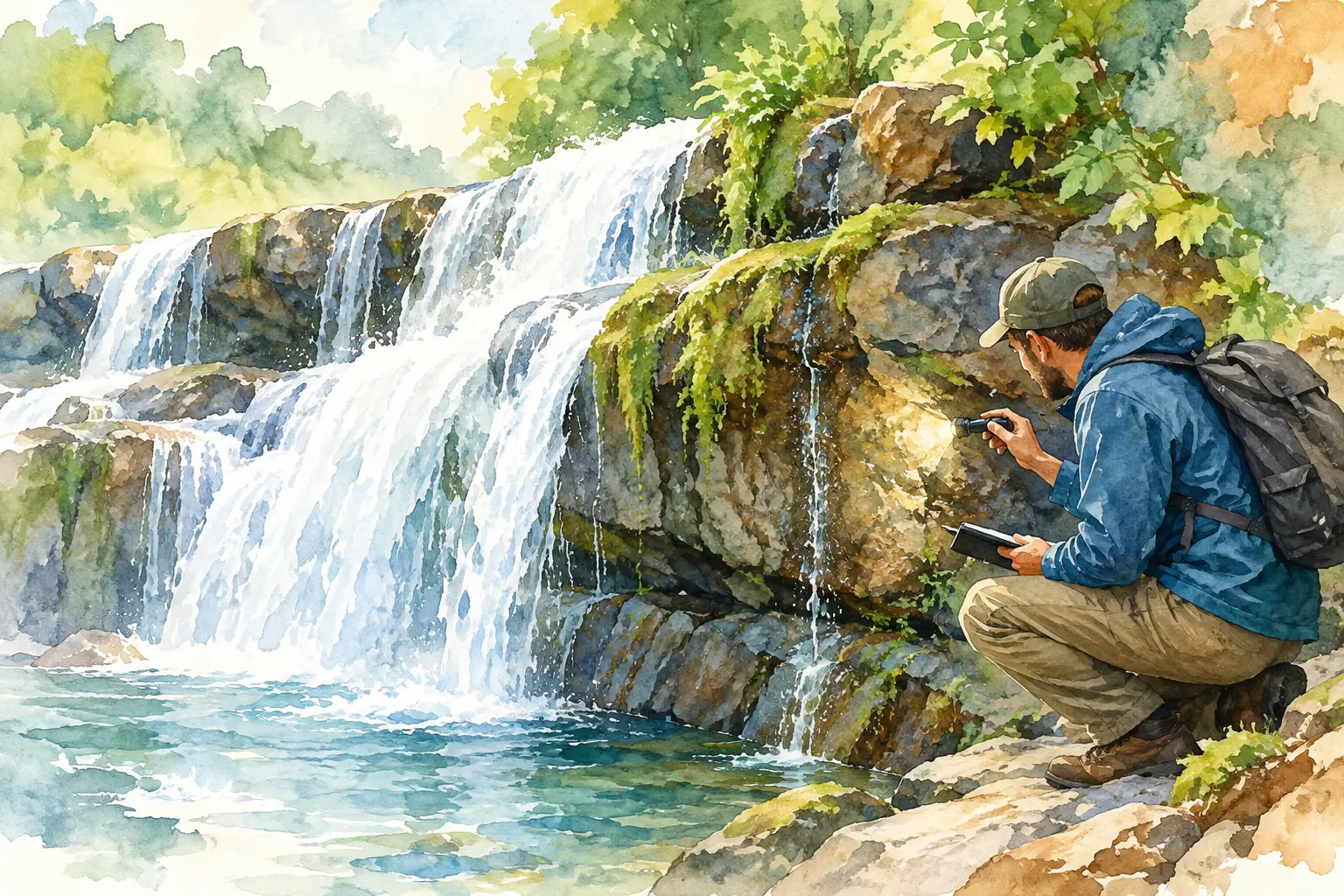
When the pump test suggests the leak is above the pond or reservoir, run the system and walk the entire watercourse slowly. Do this in daylight, ideally when the sun angle makes wet soil and subtle runoff easier to see.
Look beyond the obvious stream channel. Water can travel behind stones, under gravel, or into a planting pocket before it appears on the surface. Feel the soil at the outside edges of the waterfall, especially around curves, drops, and tightly stacked boulders. A soft, unusually saturated area is a meaningful clue.
Pay close attention to these common trouble spots:
- Low stream edges: Settling, shifting stone, or accumulated debris can create a low point where water escapes the liner.
- Splash at falls: A strong pump, narrow ledge, or misdirected cascade can throw water beyond the intended channel.
- Wicking materials: Soil, mulch, roots, fabric, or capillary action can pull water over the liner edge, even when the rockwork looks intact.
- Water behind liner folds: A folded liner can create a hidden route that directs water out of the feature.
- Connections and plumbing: Check flex pipe, unions, check valves, bulkhead fittings, and filter connections for drips or spray.
A leak at a stream edge may only appear at full pump flow. That is why it helps to watch the feature for several minutes after turning it on. Water needs time to fill each pool, find the current, and reveal where it is leaving the system.
Test Flow Before Moving Stone
A waterfall may not be leaking because of damaged liner at all. It may simply be carrying more water than its contours can contain. If a suspect area becomes wet only at full flow, reduce the pump output temporarily or partially close an appropriate flow-control valve. If the wet area dries up and the water loss slows, you may be dealing with splash or an edge that needs reshaping rather than a puncture.
This is a valuable distinction. Repositioning a few stones, adjusting a spillway, or rebuilding a low edge can often restore performance with far less disruption than a major repair. On the other hand, restricting flow too much can reduce the sound, visual movement, and biological circulation your feature was designed to provide. The right fix preserves the intended experience as well as the water.
Use the Water Level as a Map
When a pond loses water with the pump off, let it fall naturally until it stops. Do not allow fish or plants to become stressed in the process. Once the level stabilizes, inspect at and just above that waterline.
In a lined pond, leaks are often found around penetrations and transitions: skimmer faceplates, intake bays, waterfall filter connections, light fixtures, plumbing penetrations, or folds where liner meets rock. A tear can be very small and still lose a meaningful amount of water over time. Sometimes a sharp stone, root growth, animal activity, or aging adhesive is responsible. Just as often, the issue is a loose fitting or a seal that has reached the end of its service life.
Do not confuse a low water level caused by a leak with a normal operating change after the pump turns off. Waterfall plumbing drains back into the pond or reservoir when circulation stops, which can temporarily raise or redistribute the water level. Wait until the system has fully settled before marking your reference point.
Check Equipment and Auto-Fill Systems
Mechanical components deserve the same attention as liner and rockwork. A leaking pump housing, cracked pipe, loose union, or failing check valve may lose water only when the system is operating. Inspect accessible connections for dampness, mineral buildup, or tiny streams of water. A drip that lands in a hidden vault or behind landscaping can be easy to miss.
Automatic fill valves can also mask a problem for weeks or months. They keep the feature looking full while quietly adding water to compensate for a leak. If your water bill rises, the soil remains wet, or the auto-fill runs more often than usual, turn it off long enough to perform a controlled test.
For features with filtration, inspect the filter housing and any overflow routes. A clogged filter can redirect water in unintended ways, while a blocked overflow can make heavy rain reveal weak edges that normally stay dry.
Avoid the Repairs That Create Bigger Problems
It is tempting to apply sealant wherever you see moisture, but random patching can make a professional diagnosis harder later. Sealants may not bond properly to wet, dirty liner, and they rarely solve water escaping over an edge or through a plumbing joint. Similarly, dismantling a large waterfall without documenting the rock placement can turn a focused repair into an unnecessary rebuild.
Avoid adding chemicals or dyes unless you know they are safe for fish, plants, and the specific liner material. Dye tests can occasionally help in a still, contained area, but moving water disperses dye quickly and makes results difficult to interpret. In most naturalistic waterfalls, observation and isolation are more reliable.
Take photographs of wet areas, mark water levels, and note whether water loss occurs with the pump on, off, or only at certain flow settings. Those details save time and help preserve the craftsmanship of the original feature.
When to Bring in a Water-Feature Specialist
A professional assessment is worthwhile when the leak is causing erosion, affecting nearby hardscape, involving electrical equipment, or occurring in a large, complex pond or waterfall. It is also wise to call for help when fish are present, the liner is inaccessible beneath substantial rockwork, or you have isolated the general area but cannot find the exact failure point.
Experienced water-feature technicians can pressure-test plumbing, evaluate circulation, inspect liner transitions, and determine whether the best solution is an edge correction, plumbing repair, liner patch, or targeted reconstruction. At Aquascape Creations, that repair work is approached with the same care as a new build: protect the living system, respect the existing landscape, and restore lasting performance rather than simply hiding a symptom.
A well-built waterfall should feel effortless, even though it depends on many carefully balanced details beneath the surface. A patient diagnosis gives you the best chance of restoring that sound, movement, and natural beauty without disturbing more of your sanctuary than necessary.