How Much Space Does a 50,000-Gallon Recreation Pond Require?
When homeowners ask us about a big rec pond, the first number that comes up is usually volume – 50,000 gallons, a swimming pond large enough for the whole family. What they really want to know is simpler: will it fit in my backyard? The honest answer is that the space you need is always more than the water itself. A 50,000-gallon recreation pond is a system – open water, a living wetland filter, and enough room for the machine that builds it and the hundreds of tons of rock that finish it. Here is how that footprint adds up, and why the space around your pond matters as much as the pond.
What 50,000 Gallons Looks Like in Real Space
Volume converts to surface area through depth. A 50,000-gallon body of water holds roughly 6,680 cubic feet. At an average depth of about five feet, that is roughly 1,200 square feet of open water. Shape it organically, the way a natural swim pond should look, and you are looking at something close to 40 by 30 feet – larger than most two-car garages.
Practical rec ponds are rarely one uniform depth. You typically want a shallow wading shelf, a main swimming zone, and a deeper section that helps hold cooler, clearer water. That depth variation keeps the surface area in the 1,200 to 1,500 square foot range. That is the water alone. The features that keep it clean and swimmable take more room.
The Wetland Filter Zone
A recreation pond of this size cannot run on a cartridge filter in a plastic box. It needs an ecosystem – and the centerpiece of that ecosystem is a constructed wetland, a gravel-and-plant bed where water is pushed up through root systems that strip out nutrients before the water returns to the pond.
Wetland filter zones are usually sized at roughly 10 to 30 percent of the pond’s surface area, so plan on an additional 200 to 400 square feet of planted gravel bed alongside or above the water. On a sloped Bay Area lot, a hillside wetland can double as a waterfall, which uses grade you already have instead of flat yard you would rather keep.
Space for the Excavator and Materials
This is the part most homeowners never factor in, and it is where projects get expensive. Every pond is built by machines and moved by material, and machines need a path.
Budget a working corridor of at least 10 to 12 feet of clear width for a mini excavator and the dump trucks and material deliveries that follow it. You also need a staging and turning area near the dig – somewhere the rock, gravel, liner, and filter components can sit without destroying the landscape you are trying to keep. Add a few feet of planting margin and setback around the water so it does not sit on top of your fence or your neighbor’s foundation.
Put it together and a 50,000-gallon recreation pond with wetland filtration and proper access realistically occupies a working footprint of roughly 4,000 to 6,000 square feet – about 0.12 to 0.16 of an acre. In practice, that means a usable backyard of around 6,000 to 8,000 square feet or larger to place it comfortably with room to move.
Why Access Is the Single Biggest Price Factor
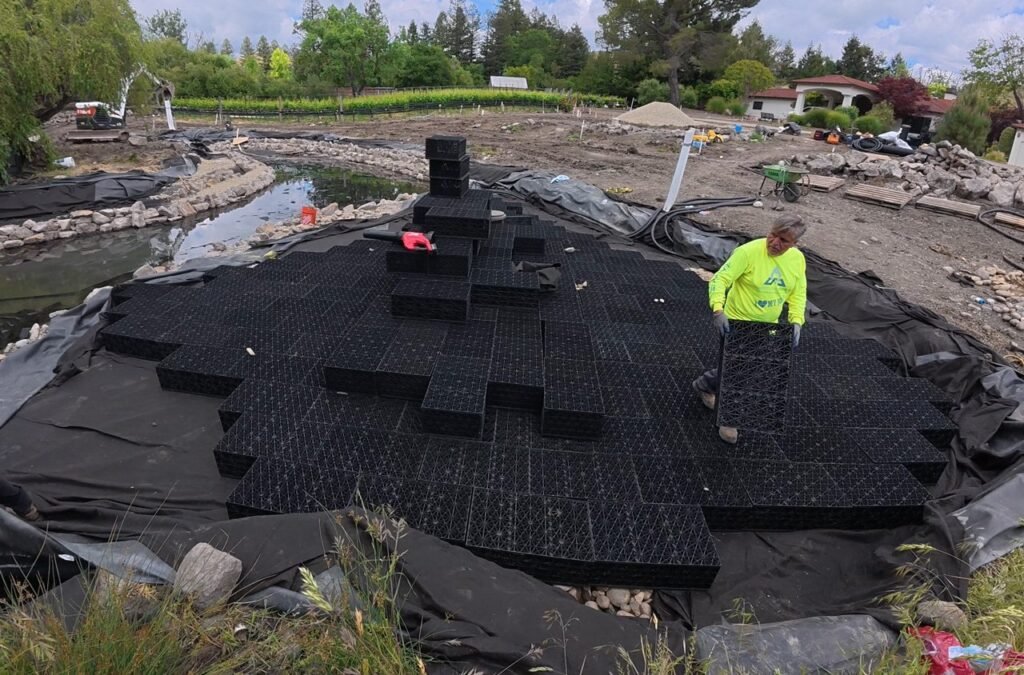
Here is the line that changes budgets: a 50,000-gallon pond can consume well over 200 tons of rock, gravel, and boulders, plus liner, underlayment, and filtration media. All of it arrives by truck at your curb.
If a machine can reach the site, that material moves in a few efficient days. If it cannot – a narrow gate, a steep grade, a tight side yard, a property where the only route is through the house or around a fence – every ton has to be moved by hand, by wheelbarrow, or across the turf with light equipment. That is hundreds of trips over distance, and it is measured in labor hours, machine time, and landscape restoration.
Access is why two identical ponds on paper can land thousands of dollars apart. It is also why the site assessment happens before design, not after. The width of your gate and the grade of your route are not details – they are line items.
The Build Sequence, in Order
A project this size lives or dies on sequence. We follow a fixed order because steps taken out of turn mean rework.
- Site assessment and access survey – measure the gate, the grade, the route, and the setbacks before anything is designed.
- Design and engineering – finalize pond dimensions, depth zones, wetland sizing, circulation, plumbing, and the utility locate and permits.
- Access prep and protection – widen or reinforce the route, lay track mats and plywood, and protect the areas you want intact.
- Excavation and spoil haul-off – dig the pond and wetland basins and remove the excavated soil.
- Material staging – bring rock, gravel, liner, and filter components as close to the work as access allows.
- Liner and plumbing install – underlayment, liner, skimmer, biofalls, wetland basin, and pump plumbing set in place.
- Rock work and wetland planting – stone edging, boulder work, and aquatic plants that power the filter.
- Fill and start-up – water, circulation, and the biological cycle that clears the water over the first weeks.
- Commissioning and handoff – system check, water management plan, and clear communication on what to expect.
Delivery Timing Is a Skill of Its Own
You cannot stage 200 tons of rock on a residential street for a month, and you cannot dig a hole and leave it open through a rainy week. Material has to arrive in a window that matches the excavation and install schedule – close enough to use, short enough to keep your driveway and street clear. That means coordinated deliveries, weather-watching, and a contractor who has run this sequence many times and knows how the timing flexes when a truck is late or the ground is wet.
The Expertise a 50,000-Gallon Rec Pond Demands
This is not a weekend build, and it is not a job for whoever happens to own a backhoe. It takes a designer who understands hydrology and aquatic ecosystems, and a builder who has managed the logistics of a large-scale project – grading, access, delivery windows, and restoration. As a Certified Aquascape Contractor, trusted by 100+ clients with a 4.8 rating and the 2026 Water Artisan of the Year award, we build these systems with the artistic eye that makes them look like they were always there and the engineering that makes them last.
Filtration Is Not Optional at This Scale
A 50,000-gallon recreation pond needs real circulation and real filtration. That means a turnover target measured in hours, not days; a mechanical skimmer to catch surface debris; a biofalls for aeration; and the constructed wetland as the nutrient engine that keeps water clear and swimmable without a chemistry set. Get the filtration plan wrong and you inherit green water, algae, and constant maintenance. Get it right and the pond mostly runs itself.
Is Your Backyard a Fit?
If your yard can hold a 50,000-gallon recreation pond with room for its wetland filter and machine access, you are a candidate for a centerpiece that changes how you use your landscape. If access is tight, that does not kill the project – it just needs to be planned and priced honestly from the start. We walk your site, measure the route, and tell you plainly what it takes. Custom-designed solutions that integrate naturally with your landscape, with clear communication every step of the way.