A wetland filter should never feel like an afterthought tucked behind a pond. When it is designed well, it becomes part of the landscape itself: a planted shelf of grasses, flowering marginals, stone, and moving water that quietly supports a healthier pond. This wetland filter design guide explains the choices that make that natural beauty work for the long term.
For a koi pond, water garden, recreation pond, or large naturalistic water feature, the wetland is more than decoration. It is a biological filter that gives beneficial bacteria, plant roots, and gravel a place to process nutrients before water returns to the pond. The result can be clearer water, less algae pressure, and a more complete, nature-inspired sanctuary.
What a Wetland Filter Actually Does
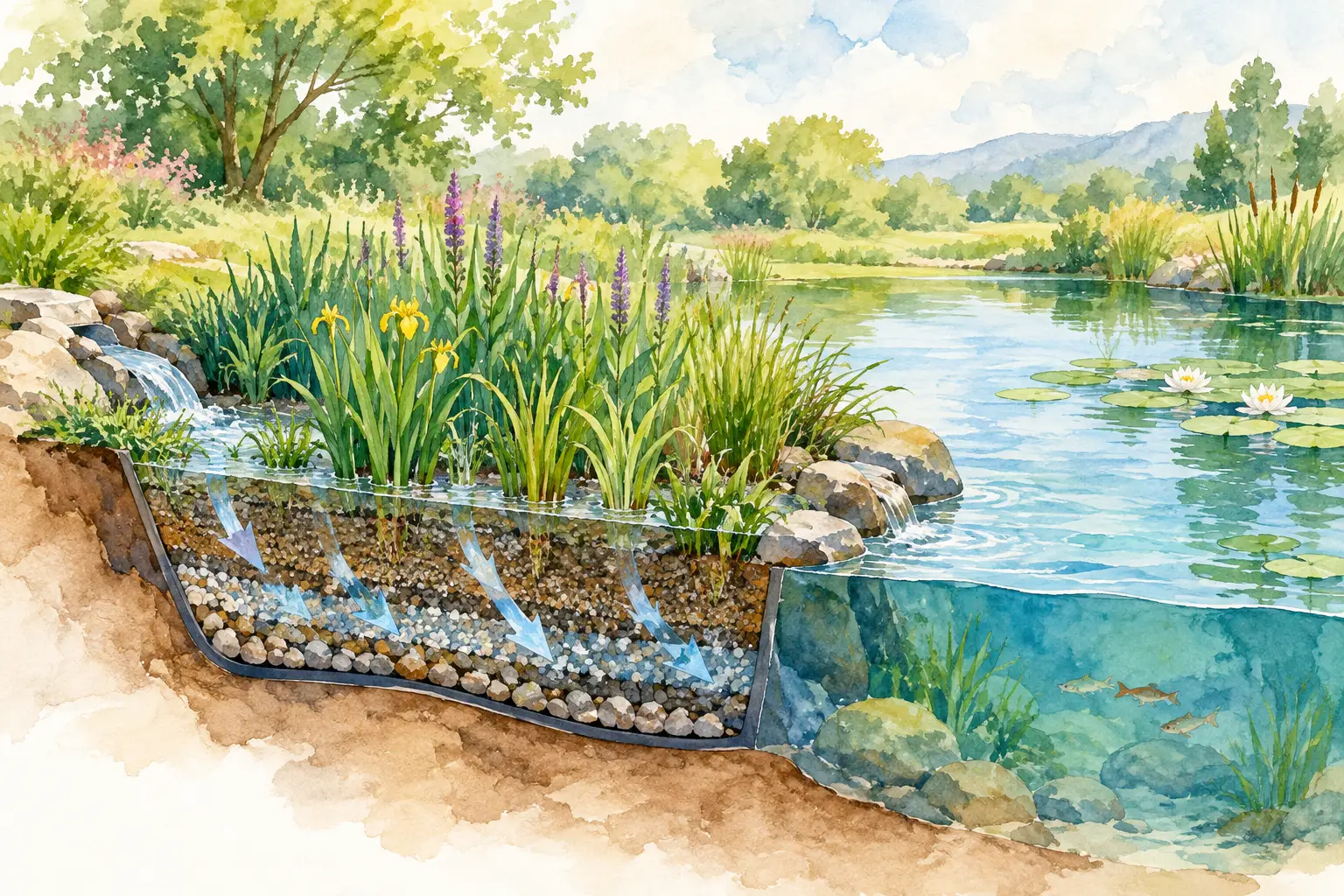
A wetland filter is a separate planted filtration zone, usually built at the edge of the pond or as an upper pool feeding a stream or waterfall. Water enters beneath the gravel through a distribution system, rises slowly through the gravel and root zone, then spills or flows back into the pond.
That upward movement matters. As water travels through the media, beneficial bacteria colonize the vast surface area around the gravel. These organisms help convert fish waste and other organic compounds into forms that plants can use. Plant roots absorb a portion of the available nutrients, while the stone captures fine debris that might otherwise remain suspended in the pond.
It is not a magic box that eliminates every maintenance task. Leaves, fish load, sunlight, runoff, and the size of the pond all affect water quality. A properly designed wetland works alongside circulation, skimming, biological filtration, and thoughtful pond care. It reduces the burden on the whole system rather than replacing the rest of it.
Wetland Filter Design Guide: Begin With the Whole System
The best wetland filter starts with the pond’s purpose. A lightly stocked water garden has very different demands than a koi pond with large fish, and a recreation pond has its own circulation, safety, and swimmer-comfort requirements. Designing a wetland by visual preference alone often leads to undersizing or uneven flow.
A common starting point for ornamental ponds is a wetland surface area of roughly 10 percent of the pond’s surface area. Heavier fish loads, full sun exposure, warm water, or a desire for exceptionally clear water may call for a larger wetland. A pond with substantial koi may need additional filtration beyond the wetland as well. There is no single percentage that fits every project.
The filter also needs enough water movement to support the pond without forcing water through the wetland too quickly. Slow, even contact with the gravel and roots is valuable, but stagnant corners are not. Pump selection, pipe diameter, elevation changes, and the return path all need to be considered together. A beautiful waterfall cannot compensate for a filter that receives too little flow or sends most of its water through one short channel.
Placement shapes both performance and beauty
An upper wetland that returns water over a small waterfall creates aeration and a pleasing focal point. It can also disguise the transition between constructed pond and surrounding landscape. A side wetland can feel more like a natural shoreline, with plantings that soften the pond edge and give wildlife a place to visit.
The right location depends on grade, views, access, and how the water feature is experienced from the home. On a sloped Bay Area property, elevation can be used to create a dramatic return stream, but the construction must also account for drainage and stable retaining details. On a compact courtyard pond, a carefully integrated side wetland may preserve more open water and keep the feature visually balanced.
Access deserves attention from the beginning. Plant thinning, inspection of plumbing, and occasional cleanout are far easier when the wetland can be reached without stepping on delicate plantings or dismantling a finished landscape.
Build for even distribution below the gravel
The distribution manifold is the hidden heart of a wetland filter. Perforated pipe is placed across the bottom of the wetland zone so incoming water spreads broadly beneath the gravel. If the manifold is undersized, poorly laid out, or lacks cleanout access, water can favor one path and leave parts of the filter underused.
A well-built system includes adequately sized plumbing, evenly spaced perforations, and accessible cleanout points. The pipe must be protected from shifting stone and installed so it can be flushed if sediment accumulates. These details are rarely visible after installation, yet they determine whether the wetland remains dependable years later.
Gravel size also affects performance. Material that is too fine can compact and restrict flow. Material that is too large offers less surface area and may not hold plants securely. Clean, appropriately sized gravel creates pore space for water movement and a stable home for roots and beneficial bacteria. Avoid using soil in the main gravel bed. It can cloud the water, contribute excess nutrients, and make future maintenance much more difficult.
Select Plants for Function, Not Just Flower Color
Wetland plants bring life, texture, and seasonal change to a pond, but they should be chosen for the site as carefully as the stone. Marginal plants with strong root systems are particularly useful because their roots extend through the gravel where water passes. Rushes, sedges, iris, pickerel-type plants, and other pond-safe marginals can provide varied height and color while contributing to the biological process.
Use a mix rather than relying on one species. Different plants grow at different rates, fill different visual roles, and respond differently to sun and seasonal temperatures. Taller plants can screen equipment or create privacy, while lower varieties keep sightlines open across the pond. In a more formal setting, plant groupings may be restrained and intentional. In a naturalistic pond, looser drifts often create the feeling that the water feature belongs to the property.
Do not overcrowd the wetland on day one. Young plants need room to establish, and a filter packed too tightly can be difficult to inspect or thin later. Expect plants to grow. Seasonal pruning and division are normal parts of maintaining a living water feature.
Avoid the Design Mistakes That Cause Frustration
Many wetland problems begin with a good idea executed too small. A narrow planted strip may look appealing, but it may not provide enough filtering area for a sunny, heavily stocked pond. Similarly, hiding every inch of the wetland behind dense planting can make an attractive feature hard to service.
Another frequent issue is treating the wetland as a place to bury debris. The filter is designed to hold fine particulates within the gravel bed, not to receive piles of leaves, soil, mulch, or lawn runoff. Grade the surrounding landscape so stormwater and fertilizer-laden runoff do not wash directly into the pond. Skimming leaves before they sink also protects water quality and reduces the organic load reaching the wetland.
Poor edge construction creates another long-term concern. Water must stay within the liner system and move on the intended route. A low edge near the wetland can allow water to escape into adjacent soil, lowering the pond level and creating a leak-like symptom. Careful liner placement, stable rockwork, and a deliberate spillway protect both the pond and the surrounding landscape.
Finally, avoid guessing at fish capacity. Koi produce significant waste, especially as they mature. Adding more fish after construction can change the filtration needs of the entire pond. A well-designed feature considers the realistic long-term fish load, not only the small fish placed in the pond during its first season.
Plan for Maintenance Without Losing the Natural Look
A wetland filter is low maintenance, not no maintenance. Regular skimmer cleaning, seasonal plant trimming, observation of water flow, and occasional manifold flushing keep it working as intended. A sudden reduction in waterfall flow, murky water, or water rising unevenly through the wetland is worth addressing early.
The most successful projects make these tasks simple. Valves and cleanouts are placed where they can be reached. Planting is arranged so service points remain discreet but accessible. Stonework is built to look timeless while allowing a trained team to inspect the system without tearing apart the landscape.
For complex ponds, professional design and construction bring particular value because filtration decisions affect excavation, plumbing, liner work, stone placement, plant selection, and future service. Aquascape Creations approaches these elements as one connected water environment, shaped around the property rather than forced into a standard layout.
A well-designed wetland filter gives a pond something rare: the ability to look increasingly at home as the landscape matures. Give it the right size, circulation, planting room, and access from the start, and the quiet work beneath the gravel can support years of clear water, healthy fish, and moments beside the pond that feel genuinely restorative.