A pond can have beautiful stonework, clear water, and a carefully planted edge, yet still feel neglected when leaves, pollen, and fish food collect on the surface. Knowing how to size pond skimmer correctly prevents that problem at its source. A properly sized skimmer quietly draws surface debris away before it sinks, breaks down, and adds unnecessary work to the pond’s biological system.
For a naturalistic pond, the skimmer is not an afterthought tucked behind a boulder. It is a hardworking part of the circulation system, protecting water quality while preserving the clean, reflective surface that makes a pond feel like a living masterpiece. The right size depends on more than the pond’s gallon count. Pump flow, surface area, fish load, surrounding trees, waterfall height, and the shape of the pond all matter.
How to Size Pond Skimmer: Start With Real Pump Flow
A pond skimmer should be sized primarily around the amount of water moving through it, not simply the dimensions of the pond. Every skimmer has a recommended flow range, usually expressed in gallons per hour, or GPH. Your pump’s actual operating flow should sit comfortably within that range.
That word, actual, matters. A pump may be labeled for 5,000 GPH, but it will not necessarily deliver 5,000 GPH once it is pushing water uphill to a waterfall, through plumbing, fittings, check valves, and filtration. This loss is called head pressure. A system with a tall waterfall or a long plumbing run can lose a meaningful portion of its advertised pump output.
Before selecting a skimmer, calculate the pump flow at the system’s total dynamic head. This includes vertical lift, pipe length, bends, valves, and any other equipment that restricts water movement. The pump performance chart provides the real number. If the pump delivers 3,200 GPH at the installed head height, choose a skimmer designed to handle at least that flow, ideally with room to spare.
Oversizing the skimmer slightly is usually a wise choice. A larger unit gives the system more capacity during leaf drop, windy weather, heavy pollen seasons, or periods when the pond sees extra use. What you want to avoid is pairing a high-flow pump with a small skimmer. The water can move too quickly through the opening, create poor debris capture, or cause the skimmer to draw down faster than the pond can replenish it.
Use Pond Volume to Set the Turnover Goal
Although pump flow drives skimmer selection, pond volume helps establish whether your circulation rate is adequate. Turnover rate refers to how long it takes for the system to move the full pond volume through the filtration loop once.
For many garden ponds, turning the water over about once every two hours can provide dependable circulation. For koi ponds, ponds with substantial fish populations, or ponds exposed to full sun and nutrient pressure, a one-hour turnover is often a stronger target. A lightly stocked water garden with generous planting may operate successfully at a slower rate, but this should be evaluated carefully rather than assumed.
For example, a 4,000-gallon pond with a one-hour turnover goal needs roughly 4,000 GPH of actual flow at the waterfall. If the plumbing and elevation reduce a pump’s output to 3,000 GPH, the pond is not receiving the circulation originally intended, even if the pump’s label says 4,000 or 5,000 GPH.
A simple planning formula is:
Pond volume ÷ desired turnover time = target actual flow rate
A 6,000-gallon koi pond with a one-hour turnover target needs approximately 6,000 GPH. That may call for one large skimmer, two skimmers, or separate circulation zones depending on the shape and complexity of the design.
Surface Area Is Just as Important as Gallons
A long, shallow pond and a deep, compact pond can hold the same number of gallons, but they do not collect debris in the same way. The long pond has much more surface area, which means more room for floating leaves, pollen, and windblown material to gather. Its skimming demand may be higher even if its total water volume is lower.
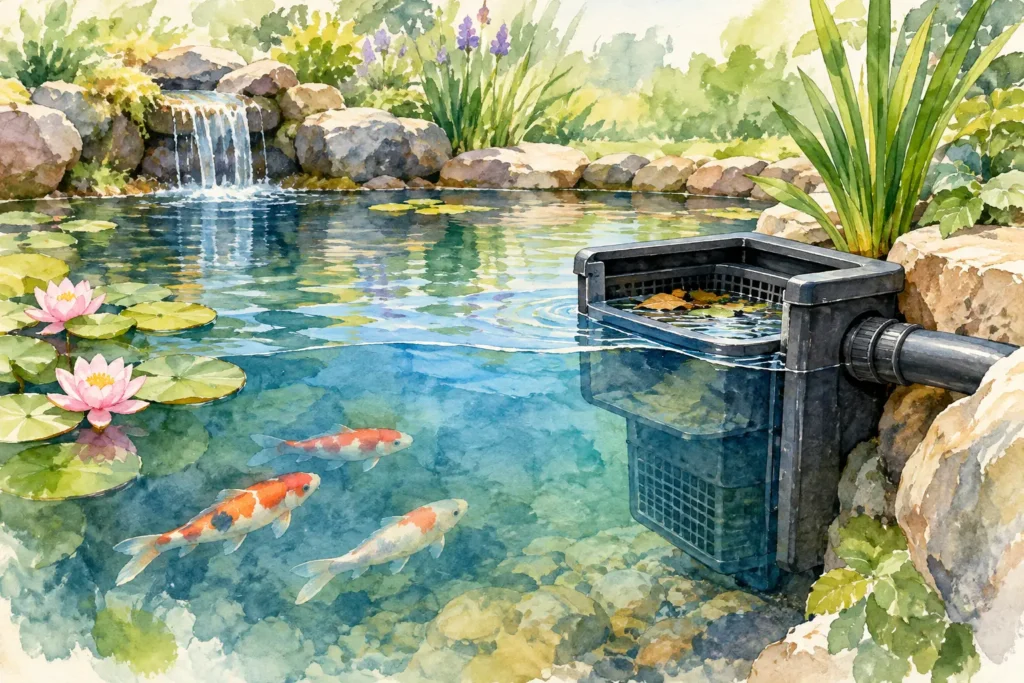
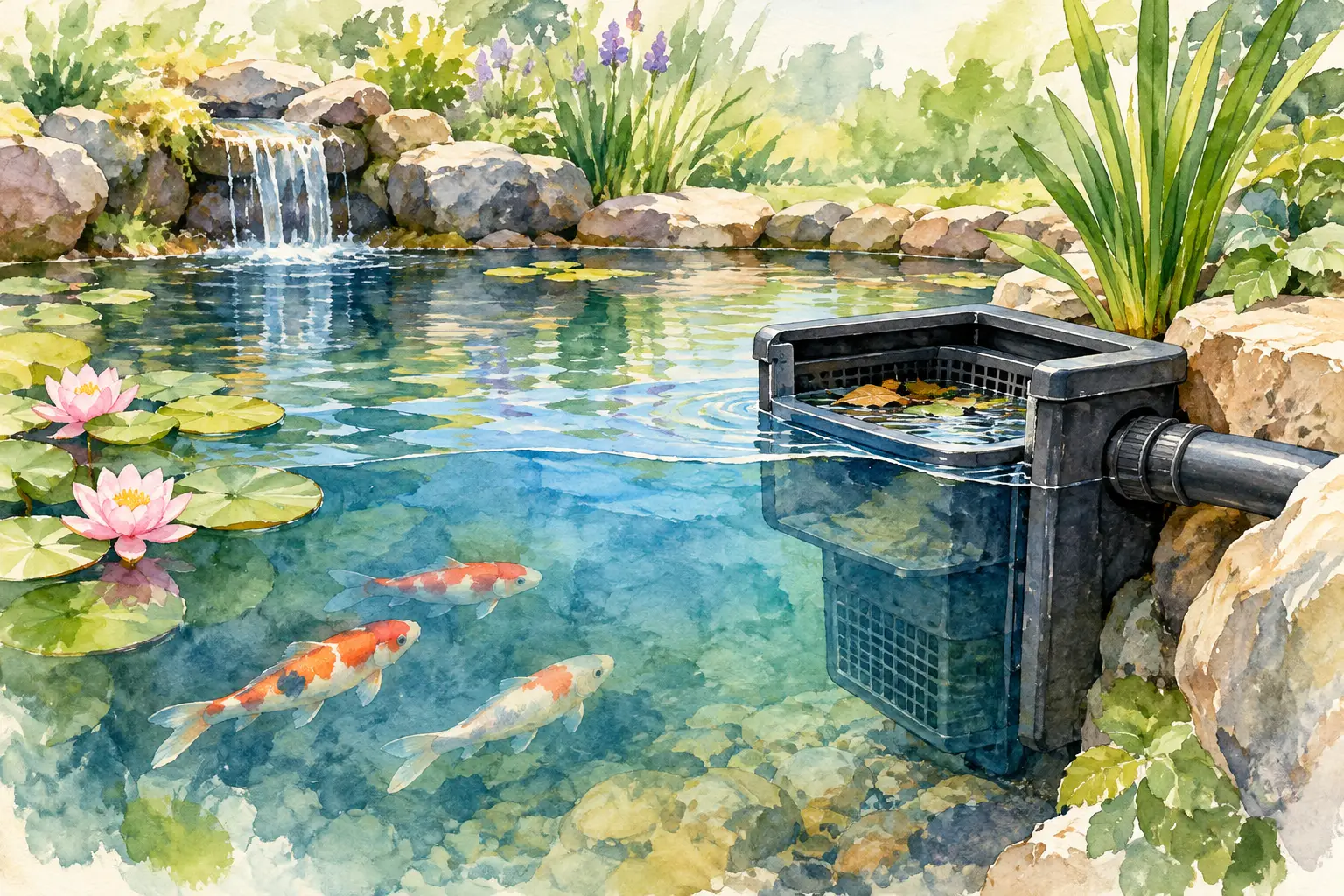
This is where skimmer weir width becomes important. The weir is the floating door or opening where surface water enters the skimmer. A wider weir pulls water from a broader section of the surface and usually handles larger flow rates more gracefully. It also creates a more natural, less concentrated draw across the waterline.
A small backyard pond with a compact footprint may perform beautifully with a single standard skimmer. A broad recreation pond, a formal water garden with long edges, or a pond designed around multiple viewing areas may need a larger weir or more than one skimmer. One unit at one end cannot always overcome a pond’s geometry, especially when the wind regularly pushes debris toward the opposite shore.
Account for Leaves, Wind, Fish, and Planting
The cleanest-looking ponds are not necessarily the ones with the biggest equipment. They are the ones where equipment capacity matches the environment. A pond beneath oaks, maples, palms, or dense ornamental landscaping needs more debris-handling capacity than an open pond with little overhang.
Consider these site conditions before settling on a skimmer size:
- Heavy leaf fall calls for a larger basket, stronger flow capacity, or multiple skimmers.
- Koi and larger fish create more organic waste, increasing the need for dependable circulation and filtration.
- Strong prevailing winds can concentrate debris in one area, affecting where skimmers should be placed.
- Large waterfalls often require higher pump flow, which can dictate a larger skimmer body and plumbing size.
- Extensive aquatic planting can naturally support water quality, but it should not be used as a reason to undersize mechanical filtration.
A pond that receives heavy leaf debris may still need periodic netting or seasonal attention. A skimmer is designed to make maintenance easier, not eliminate the realities of a landscape filled with living plants and changing seasons.
Choose One Skimmer or Multiple Skimmers
One skimmer is often enough for a compact pond with a clear circulation path. Water enters the skimmer, travels through the pump and filtration system, and returns through a waterfall, stream, or return jet positioned to guide debris back toward the intake.
As ponds become larger or more complex, a single skimmer can leave quiet areas where debris settles. These are often called dead zones. They can appear in shallow shelves, protected coves, long side arms, and broad areas far from the waterfall.
Multiple skimmers are worth considering when a pond has a large surface area, irregular outline, two distinct basins, or significant wind exposure. They can also make sense for large koi ponds and recreation ponds, where circulation must serve both water quality and the comfort of people using the space.
The goal is not to add equipment without purpose. It is to create a balanced current that gently carries floating debris toward the collection point without making the pond look or feel overly mechanical. In a well-designed natural pond, the circulation should be felt in the clarity of the water, not heard or seen as an intrusive feature.
Do Not Ignore Plumbing Size and Pump Protection
A skimmer’s plumbing has to support its intended flow. Undersized pipe creates excess friction, reduces pump performance, and may leave the waterfall weaker than expected. Larger systems commonly benefit from larger-diameter plumbing because water can move efficiently with less resistance.
The skimmer should also include easy access to its debris basket and filter mat. If maintenance requires awkward lifting, reaching into muddy water, or disassembling plumbing, it is less likely to be done regularly. Good design respects the homeowner’s time. A skimmer lid should blend into the landscape while remaining practical to open, inspect, and clean.
Pump protection is another important detail. A properly installed skimmer houses or connects to the pump in a way that protects it from larger debris and helps prevent damage if the water level drops. The exact arrangement depends on the system design, but dependable access for inspection and service should always be part of the plan.
Placement Makes the Size Work
Even the right skimmer can underperform when it is placed poorly. In most pond designs, the skimmer is positioned opposite the waterfall or primary return flow. This creates a broad, gentle current across the water’s surface, moving debris toward the skimmer rather than allowing it to collect in corners.
Wind direction should influence placement as well. In the Bay Area, local conditions can vary dramatically from one property to another due to hillsides, structures, fencing, and mature trees. Observing where leaves naturally collect after a breeze often reveals the best location for the skimmer.
A skimmer should be visually discreet but never buried so deeply in the landscape that maintenance becomes difficult. The best installations balance natural beauty with clear service access, allowing the pond to stay enjoyable year after year.
When Professional Sizing Saves Trouble Later
For a simple water garden, a basic flow calculation may be enough to narrow the options. For a koi pond, a large waterfall, a recreation pond, or a landscape with elevation changes, skimmer sizing becomes part of a larger hydraulic design. The pump, plumbing, biological filtration, returns, intake bays, waterfall spillways, and pond shape all influence one another.
Aquascape Creations approaches these systems as complete water environments, not a collection of isolated components. Selecting the right skimmer early helps protect the investment in stonework, plants, fish, and the hours you want to spend enjoying the view rather than chasing floating debris.
A well-sized skimmer disappears into the experience of the pond. You notice the shimmer of clear water, the sound of the falls, and the life gathering at the edge – not the maintenance problems that thoughtful design prevented.