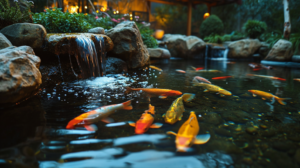

Most families don’t come to us because they want “a water feature.”
They come because they want life in the yard — moving water, color, something calming to sit near.
Koi become part of the household.
And then one morning… fish are gone.
The pond doesn’t feel relaxing anymore — it feels risky.
If that’s happened to you, you’re not alone. We see it across the Bay Area every year.
Our goal is simple:
protect your koi — while keeping the pond natural and beautiful.
Why Bay Area koi ponds attract predators
Air predators (herons, egrets, hawks)
They don’t dive.
They step in quietly… wait… and strike.
Ground predators (raccoons, skunks, cats)
Raccoons are the biggest issue. They don’t swim — they stand and grab.
They aren’t “bad.” They’re just doing what nature designed.
But once they succeed once, they remember — and they return.
What the internet suggests… and why it rarely lasts
We see homeowners spend a lot of money on:
❌ plastic herons
❌ fake alligator heads
❌ rubber snakes
❌ solar flashing lights
❌ sprays and scent repellents
Sometimes they work once.
Then predators ignore them.
We’d rather be upfront — save your money for solutions that actually protect fish.
What actually works in Bay Area koi ponds (and still looks natural)
These are methods we build into ponds and retrofit into existing systems.
Fish line barriers above the pond (subtle and effective)
Thin, strategic criss-cross fish line:
-
blocks landing
-
prevents wing spread
-
confuses herons
-
nearly disappears visually
Most visitors never notice it. Predators do.
If you’re curious whether this approach would work in your yard, we can take a look and give honest feedback.
Depth and shelf design that stops raccoons
Raccoons want shallow standing zones.
We design ponds with:
-
deeper centers
-
steeper drop-offs
-
fewer “fishing shelves”
If your pond is already built, we can often adjust key areas without rebuilding the whole thing.
We’re happy to walk your pond and point out weak spots before predators find them.
Deep stone fish caves (real refuge — not décor)
Fish need somewhere safe to disappear.
We build solid stone caves:
-
24–36 inches deep
-
tucked below the main shelf
-
wide enough for koi to enter and turn
They reduce stress and give koi real protection.
We avoid flimsy plastic “caves” that collapse, trap debris, or shift.
Edge and plant design that breaks predator approach
We disrupt walking paths with:
-
rock edging hard to stand on
-
strategic planting
-
fewer obvious “step-in here” spots
Natural. Clean. Harder to hunt.
Motion lighting (support — not the hero)
Placed correctly, motion lighting can interrupt raccoon routines.
But it works best as one layer, not the entire plan.
When all else fails — the last-resort options
There are rare yards where predators refuse to quit.
At that point, the only guaranteed protection becomes:
Electrical perimeter fence
Startles walking predators — changes the feel of the yard.
Full pond net or tight net-style coverage
Very effective — but visually intrusive.
And to be completely honest:
These protect koi, but they also remove the “natural pond” feeling you invested in.
We only recommend them when design-based solutions aren’t enough.
Common questions we get from Bay Area pond owners
“Can predators really wipe out everything?”
Sadly — yes. Sometimes overnight.
“If they get fish once, will they always come back?”
Almost always.
“Are nets best?”
They work. But most homeowners dislike the look — so we treat them as backup.
“Can a koi pond be totally predator-proof?”
Outdoors, nothing is 100%.
But smart design makes losses rare.
Our approach
A koi pond should feel peaceful — not stressful.
Every recommendation we make answers:
-
Does it still look natural?
-
Does it truly reduce risk?
-
Does it respect wildlife and protect investment?
-
Will it last long-term?
If not, we don’t push it.
If you’re unsure whether predators can reach your pond, we can evaluate and give honest advice — no pressure.
Want help before predators figure things out?
Often the problem is simple:
-
shelves too shallow
-
open landing space
-
no fish caves
-
no overhead interruption
A short walkthrough can reveal exactly what needs to change.
One last note
Predators are only part of the story.
Disease and stress also cause major koi loss — especially after adding new fish.
We cover that fully in another article so you can protect your pond from both sides.
And in a separate post, we break down predator strategies even deeper — we’ll attach that link for you to explore when ready.
If you want next, I can:
✔ tune keywords even tighter for your city pages (Livermore, Pleasanton, Dublin, San Ramon, Bay Area)
✔ format into website sections (H2/H3 spacing, images, callouts)
✔ create a short summary for Google/Meta description
Just say the word.
Got it — here’s the revised version, clean and professional, with the emojis removed — while keeping the structure, storytelling, and “Endless Customer” style tone focused on trust, education, and long-term relationships.
When Predators Discover Your Koi Pond — What Smart Pond Owners Do Next
If you’ve invested in a koi pond, you didn’t build it to feed raccoons, owls, or neighborhood cats.
You built it for beauty.
For movement.
For that quiet moment in the backyard when the world slows down.
But predators see something different.
To them, your pond can look like an easy buffet — unless it’s designed and managed the right way.
At Aquascape Creations, we’ve seen every type of predator problem, from vanished koi to ponds that become nightly hunting grounds. This guide walks you through what actually works, what doesn’t, and how to protect your fish without turning your yard into a fortress.
First — understand why predators target ponds
Predators are opportunists. They attack ponds that make hunting easy.
Here’s what usually attracts them:
-
Shallow edges with no drop-off
-
Clear, straight sight lines
-
No cover for fish
-
Overfeeding (fish learn to surface fast)
-
Lighting that highlights fish at night
When a pond lacks depth transitions and hiding zones, koi become exposed and predictable — and predators remember.
The design advantage: prevention starts before the problem
Most predator issues don’t come from “bad luck.”
They come from ponds built without biological and structural planning.
A predator-resistant pond usually includes:
1. A steep safety shelf
A 12–18 inch drop discourages raccoons from wading in.
2. Deep zones
Areas 3–4 feet deep give koi safe escape routes.
3. Aquatic planting areas
Lilies, marginal plants, and wetland zones break sight lines.
4. Overhangs and caves
Rock shelves and fish caves provide natural protection.
This isn’t about gadgets. It’s about designing a natural ecosystem that doesn’t invite trouble.
“Quick fixes” that rarely solve the problem
We hear these all the time:
-
Plastic decoy owls
-
Fake alligators
-
Shiny tape or wind spinners
-
Sprinklers that fire randomly
-
Leaving lights on at night
They might work once — maybe twice — until predators realize nothing bad happens. Wild animals learn fast.
Good design beats gimmicks every time.
What actually works when predators show up
Covered escape zones
Rock tunnels or manufactured fish caves let koi disappear instantly.
Proper depth
Shallow ponds become hunting bowls. Correct depth changes everything.
Break the line of sight
Plants, boulders, and shadows make fish harder to track.
Train your koi wisely
Feeding should be consistent, but not frantic. Avoid training them to rush to the surface at every movement.
Motion where it matters
A moving stream or waterfall helps distort reflections and visibility.
Real conversation we have with clients all the time
Homeowner:
“We lost two koi overnight. What should we buy?”
Our team:
“Before we buy anything, let’s look at the structure. If predators can walk into your pond, the problem will return.”
This is why we focus first on design and functionality — not gadgets.
Why working with a professional matters
Every yard is different. Every predator behaves differently.
Cookie-cutter advice rarely works.
When we evaluate a pond, we review:
-
Depth mapping
-
Edge construction
-
Surrounding habitat
-
Fish behavior
-
Filtration and clarity
-
Predator access points
Then we create a solution that blends into your landscape and protects your fish long-term.
No plastic zoo props. No gimmicks.
Just thoughtful, natural design.
If you’re already dealing with predators
Here’s what to do next:
-
Avoid feeding at dusk or night.
-
Reduce lighting directly on the pond.
-
Watch for footprints or feathers and take note of patterns.
-
Call us before making major changes.
A rushed fix can sometimes make the problem worse — or stress your fish unnecessarily.
Our promise
We don’t scare customers into buying things.
We educate. We build relationships. And we stand behind our work.
If predators are turning your pond into a headache, we can redesign, reinforce, or fully rebuild sections so your koi have a true sanctuary — not a target.
When you’re ready, we’ll take a look, walk you through options, and help you make a confident decision.